



HubSpot gives teams a strong starting point. The drag-and-drop builder is clean, fast, and easy to use, which is exactly why so many marketers begin there.
But scale has a way of exposing cracks. Once campaigns multiply, basic layouts become a bottleneck, branding starts to drift, and the free builder begins to feel less like a tool and more like a ceiling.
That is where the real decision appears. Should you stay with out-of-the-box templates, or invest in custom-coded architecture that gives your team more control?
The answer depends on the next 12 to 18 months of growth.
For simple newsletters, free templates are enough. For premium brand control, dynamic content, and scalable automation, the real winners usually move into free vs custom HubSpot email templates with a modular system in between.
No hidden costs. No fluff.
Let’s cut to the chase.
What are the limitations of free and marketplace HubSpot templates?
Free HubSpot templates are fast to launch, but they restrict creativity, enforce platform branding, and keep growing teams inside a rigid layout system.
The first limitation is obvious: Branding.
On the free tier, HubSpot caps users at 2,000 sends per month and places a HubSpot watermark on assets. Moving to Starter removes the watermark, but not the underlying editor constraints.
That is the real trap. The template may look easy to use, but it is still a prefabricated system.
Think of it like a manufactured home. You can move the furniture around, maybe change the paint, but you are not redesigning the structure. If your brand needs asymmetric layouts, unique visual hierarchy, or more advanced dynamic behavior, the free builder will eventually say no.
That does not make it bad. It makes it limited.
For early-stage teams, that limit is fine. For teams with serious growth goals, it becomes a quiet problem that gets louder every quarter.
What free templates really allow?
| Capability | Free / Marketplace Templates |
| Custom HTML/CSS | Restricted |
| Layout freedom | Basic grid only |
| Brand control | Limited |
| Watermark | Present on the free tier |
| Ideal use case | Simple newsletters, fast launches |
The issue is not effort. It is architecture.
So, let’s discuss what custom-coded HubSpot email templates bring to the table.
Why do brands invest in custom-coded HubSpot email templates?
Custom-coded HubSpot templates use HTML and HubL to break free from rigid grid systems, giving brands full control over layout, rendering, and advanced interactive design.
Custom code changes the game because it gives the brand a spine. Not a loose visual theme. A real system.
With HubL and HTML, teams can lock in exact brand standards, from typography and spacing to button styles and dark-mode behavior. That matters because consistency is not decoration. It is trust.
When an email feels sharp, the brand feels sharp. When the layout feels clumsy, the message does too.
Custom-coded templates also break the grid. That is the part most people underestimate. You can create layered layouts, hover effects, advanced modular sections, and more original visual patterns than the drag-and-drop editor will ever allow.
If the campaign needs to feel premium, the template cannot feel generic.
The trade-off is real, of course.
Custom code requires a Marketing Hub Professional or Enterprise subscription and development resources. But for teams that need more than a newsletter machine, that investment buys freedom.
That freedom is not abstract. It shows up in better brand governance, stronger rendering consistency, and more room for sophisticated automation later.
That brings modular HubSpot email templates into play. So, let’s see what it is all about.
What is a modular HubSpot email template system?
A modular template system combines the flexibility of custom code with the speed of drag-and-drop, giving marketers safe, reusable blocks and developers tighter control over brand standards.
This is where smart teams stop choosing extremes. They do not have to live forever with free templates, nor do they have to make developers build every email from scratch.
A modular system gives both sides a seat at the table. Developers build the master template, then lock the important pieces into reusable, controlled modules. Marketers get speed without breaking the brand in half.
That is the sweet spot. Structure with room to move.
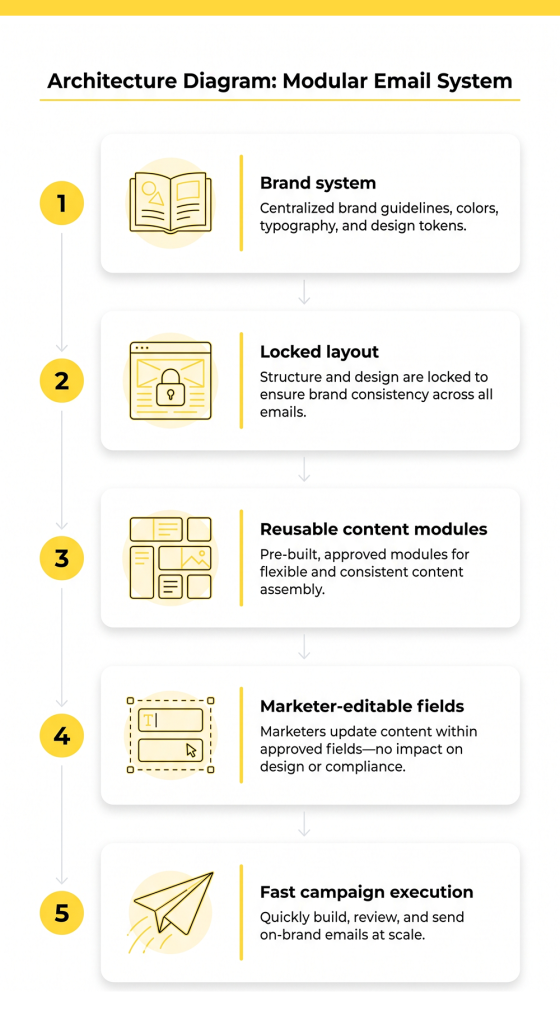
The real magic is the editing boundary. Marketers can update text, swap images, and choose approved variations, but they cannot go rogue with margins, fonts, or layout changes that weaken the whole experience.
That means fewer accidental disasters. And fewer emails that look “almost right,” which is usually the most expensive kind of wrong.
Operationally, modular systems are a quiet win. Campaigns move faster. Minor edits do not require a developer every time. And the brand stays consistent even when the calendar gets chaotic.
For scaling teams, that matters more than an elegant-looking one-off email. Because one-off is easy. Repeatable is valuable.

Free vs custom vs modular: what is the 2026 comparison matrix?
Free templates are best for immediate, low-cost execution, custom-coded templates offer maximum creative freedom, and modular systems deliver the best balance of speed and brand governance for scaling teams.
When leaders ask which route to take, they are usually asking a business question disguised as a design question. The answer is about scale, not taste.
| Feature / Metric | Free & Marketplace Templates | Custom-Coded Templates | Modular Template Systems |
| Primary benefit | Ready to use immediately with zero technical knowledge | Limitless creativity and advanced interactivity | Fast execution with strict brand boundaries |
| Custom CSS & HTML | Not permitted | Fully supported | Supported at the module level |
| Brand governance | Low | High | Maximum |
| Editing freedom | Very high, but risky | Low, unless developer-managed | Controlled and safe |
| Development cost | $0 to minimal fees | High upfront investment | Moderate investment with reusable ROI |
| Best fit | Small teams, simple newsletters | Enterprise brands, unique campaigns | Scaling teams that need both speed and control |
The matrix is clear. Free templates are easy to use but limited. Custom templates are powerful but more difficult to build. Modular systems are the practical middle path for teams that need to move quickly without sacrificing standards.
That middle path is where most serious teams land. Not because they lack ambition. Because they understand that growth eventually rewards discipline more than improvisation.
The right choice is not the most flexible one. It is the one that still works when the campaign count doubles, and the team is still breathing.
How do you decide which template model your team needs?
Choose based on where the business will be in 12 to 18 months, not just where it is today. Simple needs can stay free; scaling needs usually deserve modular or custom architecture.
If you are sending a newsletter once a week and your brand system is simple, free templates may be enough. If you are building product drops, lifecycle sequences, and campaign variations across multiple teams, the ceiling arrives fast.
That is the actual test. Not “Can we send?” But “Can we scale without chaos?”
If your team needs:
- Premium visual control
- Reusable branded blocks
- Multiple stakeholders editing safely
- Stronger dynamic content support
Then free templates will start feeling like a hand brake.
That does not mean custom code everywhere. It means thinking structurally.
A modular system often gives you the best balance. It keeps the design tight, protects the brand, and gives marketers enough flexibility to actually do their job without filing a support ticket for every small change.
In other words, it lets the team move like adults.
Wrapping up
That brings us to the business end of this article, where it’s fair to say that free templates are fine for the beginning. Custom templates are for control. Modular systems are for growth.
The smartest teams do not ask what is easiest today. They ask what will still work when the volume rises, the brand matures, and the campaign calendar gets heavier.
That is why free vs custom HubSpot email templates is not really a design debate. It is a growth strategy decision.
Connect with ourHubSpot email experts today to devise an unprecedented strategy for your team.

Ahmad Jamal - Content Writer
